Last updated 1/16/2026
Official 2026 USCCO Rulebook
Composed by the USCCO Competition Committee.
Contact info@collegecalisthenics.com for inquiries or concerns.
Download PDF1Competition Overview
1.1 Main Idea
There are four events: Sets and Reps, Streetlifting, Statics, and Freestyle. In one season, there are several regional competitions, and one national competition.
1.2 Safety Policy
Participation in USCCO competitions is undertaken at the athlete’s own risk. All competitors are expected to possess the physical ability, technical proficiency, and awareness necessary to safely perform the required movements and lifts. It is the responsibility of each athlete to ensure that they are adequately prepared, both physically and mentally, for participation.
By signing the event waiver and/or participating in any USCCO competition or activity, athletes acknowledge and accept full responsibility for their own safety and well-being. They understand and agree that the United States Collegiate Calisthenics Organization (USCCO), its affiliates, organizers, volunteers, and venue partners shall not be held liable for any injury, loss, or damages arising from participation, whether occurring before, during, or after the event.
USCCO reserves the right to remove any athlete from competition if, in the judgment of the event staff or judges, their participation poses a risk to themselves or others. Safety is a shared responsibility, and all athletes are expected to uphold professional conduct and awareness throughout the event.
1.3 What athletes can expect on competition day
Athletes will have 30 minutes guaranteed warm up time before the start of their event.
The warm-up area will have at least one pull-up bar and one set of dip bars.
1.4 Competing in multiple events
Athletes are allowed to compete in multiple events if time allows, at the Competition Architect’s discretion.
1.5 How winners are determined + benefits
1.5.1 Individual Winners
- The 1st place winners of each of the four events will qualify and be invited to the national USCCO competition.
1.5.2 Club Winners
- Each Regional competition will have an overall club winner. Club winners are determined by the total points garnered by athlete placements in each of the events. The club that has the highest number of points is the winning club:
- 1st place finish = 3 club points
- 2nd Place finish = 2 club points
- 3rd Place finish = 1 club point
- Although there is no monetary or physical prize, winning clubs will be recognized.
1.6 Number of Athletes Limit
Due to competition timing restraints, clubs are allowed to send 2 athletes per event (e.g., 2 athletes for freestyle, 2 athletes for statics, etc.). Exceptions may be made due to: a lack of participating athletes in particular events, and/or a lack of participating clubs. These decisions shall be made at the discretion of the Competition Committee.
1.7 Who Qualifies to Compete?
Any participant may compete if they meet the following requirements:
1.7.1 College Verification
You must be enrolled as a student at a postsecondary educational institution.
1.7.2 USCCO Registration
The participant must be registered with the USCCO on our website (uscco.us) and must register for their desired competition through the website.
1.7.3 Age Limit
Athletes must be 25 years old or younger to compete.
1.8 Athlete Equipment & Attire
1.8.1 General
- Participants must wear tight fitting clothing in order to allow judges to accurately assess movement form.
- Judges and loaders reserve the right to investigate an athlete’s equipment after any performances.
- Only equipment explicitly mentioned in the rules is allowed. Special cases can be admitted separately upon request (Email or DM us).
- The wearing of jewelry is the personal responsibility of the athletes.
- All violations of the rules regarding the equipment and its use during the performance will immediately result in disqualification or invalidity of the attempt.
- For safety reasons any permanent changes to the personal equipment from the manufacturer’s original design are strictly prohibited. This includes torn, cut, sewn or glued surfaces of any size.
1.8.2 Equipment
1.8.2.1 USCCO-Provided Equipment
- Dry chalk/magnesia
- Dip bars
- Pullup bars
- Dip belts
- Parallettes
1.8.2.2 Equipment Athletes May Bring
- Dry or liquid chalk/magnesia
- Parallettes
- Parallel Bars
- Gymnastics Rings (for use on floor only)
- Bosu Ball
- Dip belt
- Any item not mentioned with the express permission of the USCCO Team (Email or DM us)
- All equipment an athlete brings and uses in competition must be shared amongst all other competitors (with the exception of chalk)
1.8.2.3 Banned Equipment
- Rings that are hung from bars
- Any grip agent not expressly allowed
1.8.2.4 Dip Belts
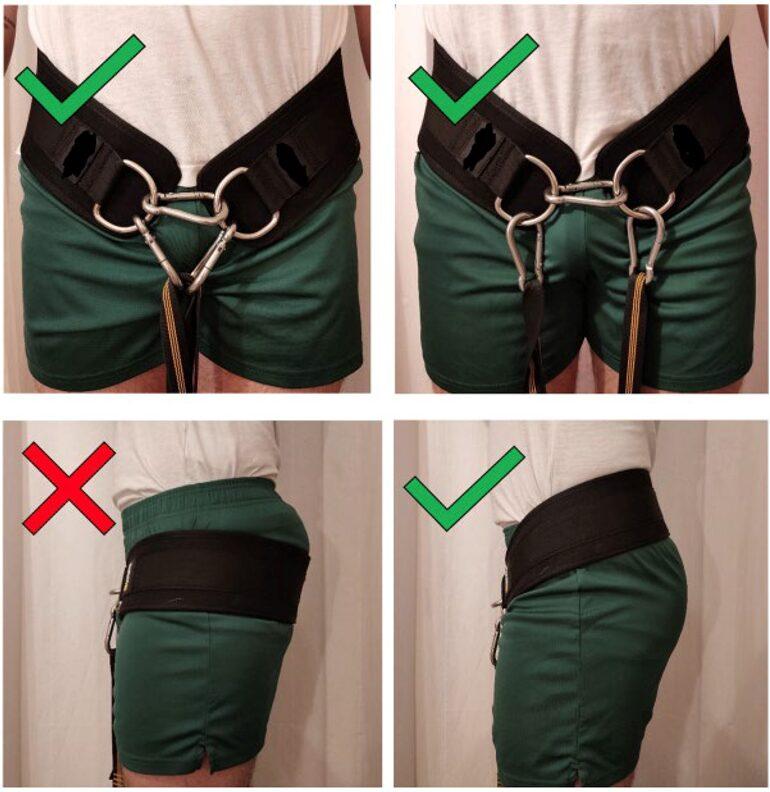
- a.A complete weight belt includes the following components: a carrying strap, two/three carabiners, and a multi-stage sling belt.
- b.The carabiners, the chain, and therefore the entire weight belt, must have a load capacity of at least 300 kg.
- c.The width of the carrying strap must not exceed 11 cm.
- d.The carrying strap may be combined with a back pad, provided that the lower end of the carrying strap is visibly marked.
- e.The chain should be at least 1.5 meters long.
- f.Athletes may use their own belts as well as those provided by the organizer.
- g.For safety reasons, all two/three carabiners must be in snug fit fashion. This, for the two carabiners will be shown by the judges with a looping through belt mechanism. For all three carabiners (one carabiner at the end of the belt connecting the sling to the belt and one carabiner to close the belt) must be attached and used as described within Figure 1.
- h.Other carabiners may be used if, upon inspection of the equipment, the load capacity meets the criteria (>300 kg).
- i.It is allowed to use one additional carabiner for extending the length of the belt – not the sling – as long as it meets the criteria described above.
- j.In addition to the sling of the belt, another sling may be attached.
- k.The belt must be worn clearly visible over the clothing.
1.8.2.5 Tape
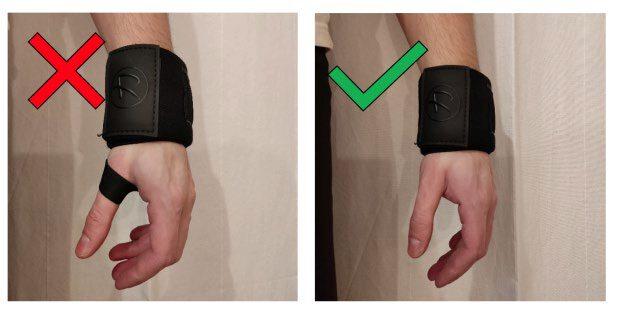
- l.Two layers of tape may be worn around the thumbs. No other patches or tapes may be worn without the official permission of the judges. These tapes may also not be used in such a way as to assist athletes in gripping the bar.
- m.Subject to the prior approval of the judges, athletes may wear tape in the event of an injury, provided it does not give those same athletes an unfair advantage.
1.8.3 Attire
1.8.3.1 Shirts
- n.All athletes are free to compete shirtless, in a sports bra, in a tank top or in a shirt.
- o.When wearing a shirt, it must always be tight or slim fit.
- p.The shirt must be constructed entirely of fabric or a synthetic textile.
- q.Athletes are allowed to wear long-sleeved shirts, meeting the following criteria:
- i.The shirt must consist of cotton, nylon/polyamide, polyester, or a combination of these fabrics.
- ii.The shirt may consist of a maximum of 5% elastane/spandex/lycra.
- iii.The percentage of the fabric blend must be visible on the waistband or on the tag sewn to the shirt. When wearing a long-sleeved shirt in combination with elbow sleeves, the shirt must be worn underneath the elbow sleeves.
- i.
1.8.3.2 Pants
- r.All athletes are free to wear long or short pants, but always tight or slim fit pants.
- s.All athletes are allowed to wear IPF-approved singlets.
- t.The pants and the singlet must be constructed entirely of fabric or a synthetic textile.
- u.Athletes are allowed to wear long-legged leggings, meeting the following criteria:
- i.The leggings must consist of cotton, nylon/polyamide, polyester or a combination of these fabrics.
- ii.The leggings may consist of a maximum of 5% elastane/spandex/lycra.
- iii.The waistband may consist of a maximum of 10% elastane/spandex/lycra to ensure wearing a precise fit for all athletes.
- iv.The percentage of the fabric blend must be visible on the waistband or on the tag sewn to the leggings.
- v.When wearing long-legged leggings in combination with knee sleeves, the leggings must be worn underneath the knee sleeves.
- i.
1.8.3.3 Wrist Wraps
- v.All athletes are permitted to wear wrist bandages.
- w.Wrist wraps, i.e. wrap bandages, may only be worn over the wrists and in no case on any other part of the body.
- x.Wrist bandages may only be worn if they meet the following criteria
- i.The bandages shall not exceed 1 meter in length and 8 centimeters in width.
- ii.A loop may be included as a safety aid. This loop may not be worn over the thumb or fingers in any competition discipline, see Figure 2.
- iii.Ordinary sweatbands may not be wider than 12 centimeters. Wearing a combination of wrist wraps and sweatbands is not permitted.
- i.
1.8.3.4 Elbow Sleeves
- y.All athletes are permitted to wear elbow sleeves.
- z.Elbow sleeves, i.e. cylindrical sleeves, may only be worn over the elbow and in no case on any other part of the body.
- aa.Wearing a combination of elbow sleeves and elbow bandages is not permitted.
- bb.Elbow sleeves may only be worn if they meet the following criteria:
- i.The sleeves must consist of a neoprene layer alone or a neoprene layer with a non-supportive layer of another fabric over that neoprene layer.
- ii.The sleeves must be sewn around both ends. The sleeves must be cut in such a way that they do not provide excessive assistance or disproportionate recoil in the area of the athletes’ elbows at the reversal point of the dip.
- iii.The sleeves must not exceed a maximum thickness of 7 mm and a maximum length of 30 cm.
- iv.No additional materials may be attached to the sleeves, nor may any changes be made to the manufacturer’s original design (e.g. for the purpose of narrowing). The sleeves must be cylindrical throughout and show no holes or similar damage to the material.
- v.In addition to the neoprene sleeves described above, so-called single ply sleeves are allowed.
- i.
2Streetlifting
2.1 Overview
In USCCO-sanctioned streetlifting events, there are two exercises: weighted pullup and weighted dip. The goal of the athlete is to maximize the total combined lifted weight for weighted pullup and weighted dip. The athlete with the highest combined lifted weight wins
2.2 Weight attached to weight belt
Only weight attached to a weight belt given to the athlete will be counted.
2.3 Absolute vs Relative Winner
There will be an Absolute winner and a Relative winner. The Absolute winner is the person who lifts the most total weight. The Relative winner is the person who lifts the most total weight relative to their bodyweight, according to a weight coefficient. Only the absolute winner will receive the opportunity to go to nationals, but the relative winner will receive recognition.
2.4 3 attempts
The athlete gets 3 attempts for both exercises to maximize their total lifted weight.
2.5 Skipping attempts
Athletes may skip attempts if desired.
2.6 In the event of a Tie
In the event of a tie where two totals are the same, the athlete with the lower bodyweight is declared the winner. If two athletes weigh-in at the same bodyweight and eventually achieve the same total at the end of the competition, both athletes are declared as winners and will share the final placement.
2.7 Weigh-Ins
Athletes will be required to weigh-in the day of competition for tie-breaking purposes, and in order to recognize the relative winner.
2.8 Weight Attempt Selection
Before the competition starts, athletes must register with the front desk and enter first weight attempts for the pullup and the dip.
The minimum weight attempt is +2.5 lbs.
If an athlete has a successful 1st or 2nd attempt in the weighted pull or weighted dip, then they must use a heavier weight by at least 2.5 lbs on the next attempt.
If an athlete fails the 1st or 2nd attempt, they are free to decrease or increase the weight on the next attempt however they’d like, within 2.5 lbs increments. They may also attempt the same weight.
2.9 Order of Athletes
Athletes will lift in ascending order of first weight attempts for each exercise, i.e., the athlete attempting the least weight for an exercise will go first.
2.10 Rest time
Athletes are entitled to 6 minutes of rest time between attempts.
Athletes are entitled to 30 minutes of rest time between exercises.
2.11 Time Limit After Announcing Name
Once an athlete’s name is called to the platform by either Head Judge or Host, they have 60 seconds to start the exercise.
2.12 Judging
There will be 2 judges observing an athlete during their attempt. A lifter has a successful attempt when both 2 judges signal with a “thumbs up”. Otherwise, the attempt is unsuccessful.
- There are 2 judges on the platform: one side “head” judge giving signals & another side judge observing.
2.13 Procedure
To ensure consistency and avoid mistakes in athlete attempts, all athletes will follow the same procedure of performance:
- 1.After the athlete’s name is called, the athlete will step up to the performance box in which the athlete, with the help of a judge, will load his/her belt with the proper amount of weight for the attempt. This weight will rest on the box.
- 2.The athlete will step up onto the box after the loading is confirmed and competed & show a visible confirmation to the head judge of preparedness. The weight is still slack at this point & resting on the box.
- 3.When ready, the head judge will verbally state “Mount!” to have the athlete mount the bars, a staff member will ensure that the weights properly roll off the box & that the box is moved out of the way if needed.
- 4.When the head judge sees that the athlete is in a stationary & unmoving start position, they will then state “Go!” to have the athlete perform the repetition.
- 5.After the repetition is completed & the athlete returns to the original starting position, the athlete will wait for the head judge’s confirmation that the athlete is stationary & unmoving before calling “Dismount!” in which the athlete returns to the box.
- 6.The judges will give their confirmation of a valid or invalid repetition, with a brief discussion if necessary. The head judge will then communicate the scorekeeper the information.
2.14 Judging System
- In order to ensure clear and rule-compliant judging of the competition discipline attempts, each judge is assigned to validate specific rep criteria points (Head judge holds red and black cards, side judge holds yellow and blue cards). Errors in judging should thereby be reduced to a minimum.
- A lifter has a successful attempt when both judges signal a “thumbs up”. Otherwise, the attempt is unsuccessful.
- The decisions of the judges regarding the validity of an attempt are final.
- Emotionality is human and will be tolerated. However, disproportionate discussions with the judges about their decision are not allowed and may result in disqualification or dismissal from the current competition. This includes, among other things, verbal and physical attacks on the judges as well as excessive delaying of the competition.
- For better clarity for the athletes, coaches, and viewers, a card system with different colors represents the reasons for a “no rep”. See Table 1 for full explanation of the color card system.
- In case of a “no rep,” the judges will show the colored card corresponding to the reason for the invalid attempt. A brief discussion between the judges may be held immediately after the repetition if absolutely necessary.
| Color | Pull-Up | Dip |
|---|---|---|
| Red | Invalid height | Invalid depth |
| Black | Ignored signal from judgeIllegal equipment | Ignored signal from judgeIllegal equipment |
| Yellow | Kicking/kipping | Kicking/kippingLoss of control (spine hyperextension) |
| Blue | Bent arms at start of rep | Bent arms at start of rep |
* See Successful Rep Criteria for in depth information
2.15 Challenge
The challenge policy applies if the technical requirements can be met by the organizer.
2.15.1 Challenge Policy
Athletes are entitled to challenge judges’ decisions on an attempt once per competition. When a challenge is issued, the Head Judge will review a replay of the rep and make a final decision.
2.15.2 What Can Be Challenged
The athlete may only challenge a decision if the verdict of one judge is “invalid.” Therefore, the attempt may not be challenged if two evaluate an attempt as “invalid.”
2.15.3 When To Issue Challenge
Athletes must request a replay directly after the overall decision for the challenged attempt has been made before putting his/her next weight attempt selection. If a challenge is issued, the event will remain paused until a decision has been made by the judges upon reviewing the replay.
2.15.4 Who To Issue Challenge To
Athletes must go to the Head Judge to issue a challenge.
2.15.5 Use of External Video in Challenges
External video recordings from third parties (e.g., from the athletes’ area as well as from the audience) are not permitted and cannot influence the decision of the judges.
2.16 Rep Criteria
Judges are trained to be strict on movement execution. To understand exactly what constitutes a successful rep, see Successful Rep Criteria.
3Sets and Reps
3.1 Overview
In the Sets and Reps competition, athletes attempt to complete a sets and reps routine in the fastest time possible. The fastest athlete is the winner.
3.2 Routine Release Date
Every season, the sets and reps routine changes.
At least 3 months out from the first competition date, the competition architects will release the season’s sets and reps routine.
3.3 Time Limit
The cutoff time may be established at the Competition Committee’s discretion & will be announced before and during the competition. However, if no cutoff time is communicated, it is assumed that any athlete exceeding 15 minutes during a competition will receive a “Did not finish” (DNF).
3.4 Potential Movements
Any of these movements may be included in the sets and reps routine:
| Movement | Category |
|---|---|
| Push Up | Push |
| Dip | Push |
| Pull Up | Pull |
| Ring Row | Pull |
| Squat | Legs |
| Pistol Squat | Legs |
| Switching Lunges | Legs |
| Jumping Squat | Legs |
| Toes-to-bar | Abdominal |
| Muscle Up | Compound |
| Pull Up to Muscle Up | Compound |
| Burpee | Compound |
| Pull Up to Toes to Bar | Compound |
3.5 Rep Criteria
Judges are trained to evaluate athletes to strict movement standards. To understand exactly what constitutes a successful rep, see Successful Rep Criteria.
3.6 2026 Sets and Reps Routine
The 2026 USCCO sets and reps routine is the following:
Men:
- Phase 1:
- 5 Pull-Up to Muscle-Up
- 30 Switching Lunges
- 20 Dips
- Phase 2:
- 4 Pull-Up to Muscle-Up
- 25 Switching Lunges
- 15 Dips
- Phase 3:
- 3 Pull-Up to Muscle-Up
- 20 Switching Lunges
- 10 Dips
- Burnout:
- 25 Pull-Ups
- 100 Push-Ups
Women:
- Phase 1:
- 5 Pull-Up to Toes-to-Bar
- 30 Switching Lunges
- 10 Dips
- Phase 2:
- 4 Pull-Up to Toes-to-Bar
- 25 Switching Lunges
- 10 Dips
- Phase 3:
- 3 Pull-Up to Toes-to-Bar
- 20 Switching Lunges
- 7 Dips
- Burnout:
- 7 Pull-Ups
- 35 Push-Ups
4Statics
4.1 Format
There are two rounds of competition: the Qualifier, and the Head-To-Head.
4.1.1 Qualifier
In the Qualifier, every athlete performs for 45 seconds. The top 4 athletes are selected by the judges and move on to the second and final round, the Head-To-Head.
If there are 4 athletes or less to begin with, the qualifier round is skipped, and athletes go straight to the Head-To-Head.
4.1.2 Head-To-Head
The Head-To-Head is a series of 45 second sequences in which each competitor will perform in intervals, switching out with one another once their 45 second slot is finished, with only a 10 second break between switches. Once the first participant completes their 45 seconds and exits the event area, the next participant moves in and their 45 second slot begins.
Each competitor will perform 2 sequences of 45 seconds, and each participant will have the opportunity to conduct a better performance once their turn comes back to them, as the participant’s best of either of the 2 sequences will be used in the final ranking.
If a participant wishes not to perform for the entirety of the 45 second round, but to instead rest & recover for their proceeding round, they may wait in the event area until the 45 seconds is complete & the next participant swaps in.
Judges will decide the placement order of the top 4 athletes.
4.2 Starting
As soon as the athlete initiates a movement, (or in the head-to-head, if the 10 second break between athletes expires), the time starts.
4.3 Ending
The athlete may end their round early by making an “X” symbol crossing with their arms. The following athlete is still entitled to rest for the remainder of the preceding athlete’s time, plus the 10 seconds between athletes in the head-to-head.
4.4 Equipment
At a USCCO-sanctioned statics competition, athletes may expect to be provided parallel dip bars, parallettes, and the high pull up bar. Athletes may bring their own equipment that the USCCO does not already provide with the USCCO’s express permission.
4.5 Judging
4.5.1 Ranking Process
A panel of 3 judges will be provided. The final ranking of athletes is determined through a process called adaptive comparative judging, in which pairs of athlete performance videos are presented to the judges, with each judge deciding which athlete is better. After enough pairs have been presented and judged, a final ranking list is produced.
Judges will be evaluating athletes holistically based on the athlete’s performance execution, difficulty, and creativity/flow.
4.5.2 Expected Movements:
The types of movements that are expected to be performed within this event, and are judged on, include the movements under these categories:
- Balance Movements
- Static Holds
- Power Dynamics
4.5.3 Notes on Statics Execution
Execution describes the overall quality and control of your performance.
Possible reasons for deduction
- 1.Using momentum
- 2.Lever at incorrect angle
- 3.Unclean entrance and/or exit
- 4.Not holding movement long enough
- 5.Falls
- 6.Fails
4.5.4 Notes on Statics Difficulty
Difficulty describes the overall complexity and challenge of your routine.
Factors that will increase your routine’s difficulty
- 1.Harder progressions
- 2.Movement combinations
- 3.Transitions
4.5.5 Notes on Statics Flow/Creativity
Flow and creativity describe how uniquely, smoothly, and expressively the athlete presents their routine. This category rewards originality, rhythm, and the athlete’s ability to connect movements into a cohesive performance.
Factors that will increase your routine’s Flow/Creativity:
- 1.Smooth/Unique Transitions
- 2.Original Movement Choices
- 3.Expression & Style
- 4.Integration of musicality or rhythm when applicable
- 5.Creative Use of Space/Equipment
5Freestyle
5.1 Format
There are two rounds of competition: the Qualifier, and the Head-To-Head.
5.1.1 Qualifier
In the Qualifier, every athlete performs for 60 seconds. The top 4 athletes are selected by the judges and move on to the second and final round, the Head-To-Head.
If there are 4 athletes or less to begin with, the qualifier round is skipped and athletes go straight to the Head-To-Head.
5.1.2 Head-To-Head
The Head-To-Head is a series of 60 second sequences in which each competitor will perform in intervals, switching out with one another once their 60 second slot is finished, with only a 10 second break between switches. Once the first participant completes their 60 seconds and exits the event area, the next participant moves in and their 60 second slot begins.
Each competitor will perform 2 sequences of 60 seconds, and each participant will have the opportunity to conduct a better performance once their turn comes back to them, as the participant’s best of either of the 2 sequences will be used in the final ranking.
If a participant wishes not to perform for the entirety of the 60 second round, but to instead rest & recover for their proceeding round, they may wait in the event area until the 60 seconds is complete & the next participant swaps in.
Judges will decide the placement order of the top 4 athletes.
5.2 Starting
As soon as the athlete initiates a movement, or if the 10 second break between athletes expires, the time starts.
5.3 Ending
The athlete may end their round early by making an “X” symbol with their arms.
5.4 Equipment
At a USCCO-sanctioned freestyle competition, athletes may expect to be provided parallel dip bars, parallettes, and the high pull up bar. They may also use the floor. Athletes may bring their own equipment that the USCCO does not already provide with the USCCO’s express permission.
5.5 Judging
5.5.1 Ranking Process
A panel of 3 judges will be provided. The final ranking of athletes is determined through a process called adaptive comparative judging, in which pairs of athlete performance videos are presented to the judges, with each judge deciding which athlete is better. After enough pairs have been presented and judged, a final ranking list is produced.
Judges will be evaluating athletes holistically based on the athlete’s performance execution, difficulty, and creativity/flow.
5.5.2 Expected Movements:
The types of movements that are expected to be performed within this event, and are judged on, include the movements under these categories:
- Acrobatic Dynamics
- Power dynamics
- Balance Movements
- Statics
5.5.3 Notes on Freestyle Execution
Execution describes the overall quality and control of your performance. Movements should be cleanly performed with deliberate body control throughout takeoff, flight, and landing. Failed or incomplete movements will reduce your performance execution.
Possible reasons for deduction
- 1.Unclean body alignment (e.g., bent legs, uneven shoulders, off-axis rotations)
- 2.Unintended contact with the bar or equipment (e.g., scraping feet, brushing bar, knee hits)
- 3.Loss of balance or incomplete rotations during transitions or landings
- 4.Unclean entrance and/or exit between elements
- 5.Not holding movement long enough
- 6.Falls
- 7.Fails
5.5.4 Notes on Freestyle Difficulty
Difficulty describes the overall complexity and challenge of your routine. Only movements that are successfully completed or held will count toward this score.
Factors that will increase your performance difficulty
- 1.Harder movements/progressions
- 2.Successful completion of movements with high risk or low margin for error
- 3.Consecutive or connected difficult elements with minimal rest between (e.g., combo sequencing)
- 4.Transitions
5.5.5 Notes on Freestyle Flow
Creativity/Flow describes how uniquely, smoothly, and expressively the athlete presents their routine. This category rewards originality, rhythm, and the athlete’s ability to connect movements into a cohesive performance.
Factors that will increase your performance Creativity/Flow:
- 1.Smooth/Unique Transitions
- 2.Original Movement Choices
- 3.Expression & Style
- 4.Integration of musicality or rhythm when applicable
- 5.Creative Use of Space/Equipment
6Successful Rep Criteria
6.1 Muscle-Up
- a.A complete repetition of the muscle up involves beginning in a pull-up position, navigating over the top of the bar into the bottom of a straight bar dip with the athlete’s chest over the bar, and then performing the top of the dip before swinging back down into the starting pull-up position.
- b.Athletes must achieve straight arms at the bottom of the movement repetition.
- c.Athletes must achieve straight arms at the top of the movement repetition.
- d.Athletes may not perform a ‘chicken-wing’ muscle up, in which one elbow navigates over the bar before the other. Both elbows must simultaneously navigate over into the straight bar dip position during the muscle-up transition.
- e.Any large momentum generated with a tilting motion in the pelvis or with a kicking motion of the legs is a kip. If the athlete’s knees come above the athlete’s hip joint/waistline during the kip, it is considered a no-rep.
- f.Athletes may not use a full false grip, defined as a grip in which at least one wrist or forearm touches the bar [1].
- g.Demonstration: https://www.instagram.com/p/DSaT4suDWiY/
6.2 Pull-up
- a.Athletes may use whichever grip they desire.
- b.Athletes must begin their performance with no swing.
- c.Athletes must achieve straight arms at the bottom of the repetition.
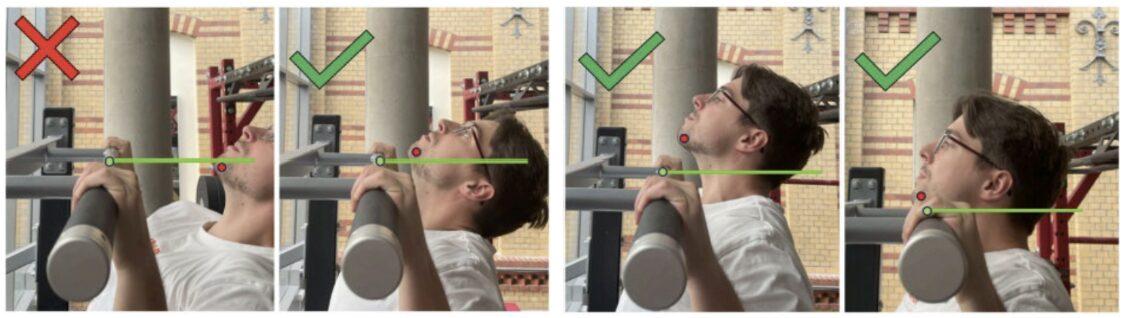
- d.Athletes must have their chin be over the pull-up bar plane at the top of the repetition, as depicted in Figure 1.
- e.Kipping is not allowed. A minimal change in the knee and hip angle, that is not to the athlete’s advantage, is allowed.
- f.Demonstration: https://www.instagram.com/p/DSVwWXUkktW/
6.3 Dip
- a.Athletes cannot use a “thumb-over” grip where the thumbs are positioned on the same side of the bar as the other fingers [1].
- b.Athletes must begin their performance with no swing and arms fully locked out at the top of the dip movement.
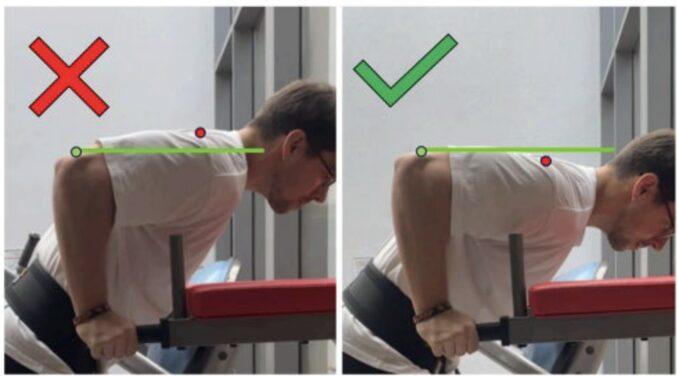
- c.Descend until the athlete’s rear delt is visibly below the elbow joint at the bottom of the repetition, as shown in Figure 2 [1].
- a.STREETLIFTING ATHLETES ONLY: The highest point from the bottom of the dip belt must be at least level with the highest point of the dip bars. See Figure 3 [1].
- a.
- d.Athletes must achieve straight arms at the top of the repetition.
- e.Maintain a straight and fixated back inclination. If dips on parallel bars are executed by tilting forwards, with the pelvis area stationary, then these repetitions will not be counted.
- f.No excessive “banana” hyperextension of the spine.
- g.No kipping is allowed. A minimal change in the knee and hip angle, that is not to the athlete’s advantage, is allowed.
- h.Demonstration: https://www.instagram.com/p/DSaTGRmjeZ1/
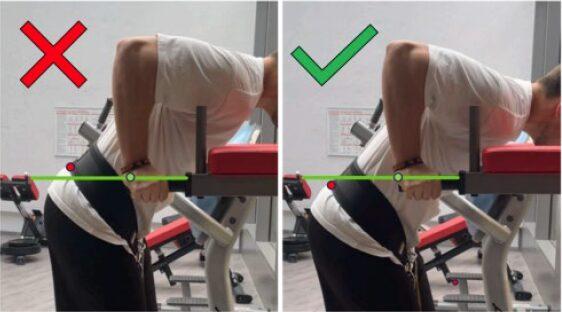
6.4 Push-up
- a.Athletes are free to use whichever grip variation they desire.
- b.Athletes must achieve straight arms at the top of the repetition.
- c.Athletes must descend until the athlete’s rear delt is visibly below the elbow joint at the bottom of the push-up repetition, as shown in Figure 5.
- d.Shoulders, hips, and talus (ankle bone) must be in a straight line through the body
- e.Demonstration: https://www.instagram.com/p/DSVwBMQEpNY/
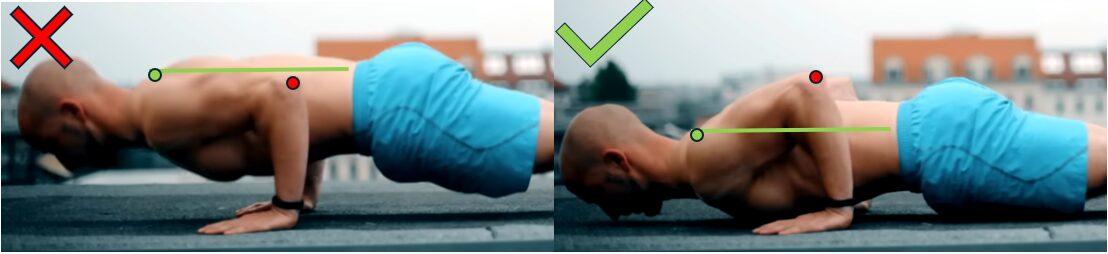
6.5 Ring Row
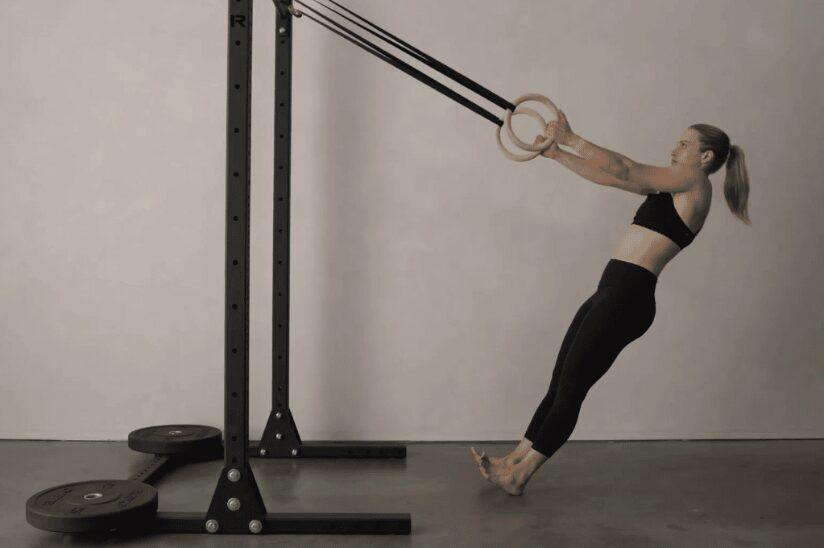
- a.Athletes must perform the repetitions with the starting position of their body at 45 degrees with the ground. See Figure 4 for reference.
- b.Athlete’s elbows must surpass the back of the body at the top of the row movement, see Figure 5 for reference.
- c.Athletes must achieve straight arms at the bottom of the row movement.
- d.Athletes' legs must be straight for the entirety of the movement.
- e.Athlete’s feet must be at or narrower than shoulder width
- f.Shoulders, hips, and talus (ankle bone) must be in a straight line through the body
- g.Any momentum generated by any body part other than the arms/back will disqualify the rep.
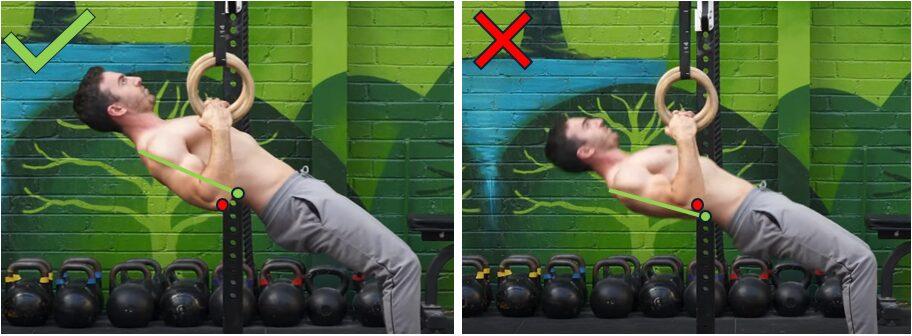
6.6 Burpee
- a.The athlete must jump off the ground while simultaneously raising their hands above their head, before returning to the ground and lowering to perform a push-up to complete the repetition. See video https://youtu.be/FmG4fL79-J0?si=b3Aqm9OM_bw74g48&t=745 for reference of acceptable repetitions.
- b.The athlete must position both wrists above their head while jumping.
- c.The athlete must adhere to the push-up standards previously outlined, with the exception of banana back allowed, as well as legs touching the ground, due to the intensity of the exercise. The athlete’s chest is also allowed to touch the ground.
- d.The athlete may not “walk down” or “walk up” to or from the pushup position. The athlete’s feet must leave the ground simultaneously and in line with each other.
- e.During the descent and ascent to and from the pushup position, the athlete’s feet must stay in line with each other. In other words, they must leave the ground simultaneously.
- f.The athlete may not support themselves on the thighs on the way up.
6.7 Toes-to-Bar
- a.The athlete must begin from a dead hang position with arms fully extended and legs straight downward.
- b.A valid repetition requires the athlete to raise both feet simultaneously to make visible contact with the pull-up bar at the same time. The contact must occur between the hands on the bar.
- c.The repetition is complete when the athlete returns to the fully extended dead hang position with legs straight and motion under control.
- d.The athlete must maintain straight legs throughout the movement. Any visible bend at the knees during the upward or downward phase will result in a no-rep.
- e.Momentum generation through torso swinging is not allowed. The athlete must maintain a vertical shoulder–hip line throughout the concentric portion of the movement. Any rocking motion where the torso swings backward and forward to assist the lift will result in a no-rep.
- f.The athlete may use either a pronated or supinated grip, but the grip must remain consistent throughout the performance of the set.
- g.Any asymmetrical contact (e.g., one foot touching before the other) or missed bar contact does not count as a valid repetition.
- h.Demonstration: https://www.instagram.com/p/DSaTiUlDQ7u/
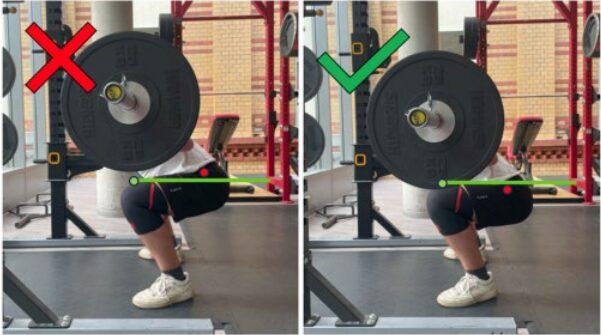
6.8 Squats
- a.The athlete begins with both feet on the ground before they must bend the knees and lower the body until the top surface of the legs at the hip joint (anatomically defined as the inguinal crease) is lower than the top of the knees, see Figure 6 for reference.
- b.The athlete must achieve an upright and straight leg position at the top of the movement.
- c.The athlete may not make a double rocking movement at the lowest point of the squat.
- d.The athlete may not make a downward movement during the concentric phase of the repetitions, i.e., the athlete may not go down again until they have reached the top of the repetition.
- e.The athlete may not support themselves on the thighs with the elbows or upper arms.
- f.The athlete may position their arms wherever they’d like, but they may not generate any momentum with the arms (e.g., swinging the arms)
6.9 Pistol Squats
- a.The athlete begins with one foot of their choice on the ground before they must bend the knees and lower the body until the top surface of the legs at the hip joint (anatomically defined as the inguinal crease) is lower than the top of the knees
- b.The athlete must achieve an upright and straight leg position at the top of the movement.
- c.The athlete may not make a double rocking movement at the lowest point of the squat or a downward movement during the concentric phase of the repetitions [1].
- d.The athlete may not make a downward movement during the concentric phase of the repetition, i.e., the athlete may not go down again until they have reached the top of the repetition.
- e.The athlete may not touch the ground with their freestanding leg.
- f.The athlete may not support themselves on the thighs with the elbows or upper arms.
- g.The athlete may position their arms wherever they’d like, but they may not generate any momentum with the arms (e.g., swinging the arms)
6.10 Switching Lunges
- a.The athlete begins with one foot forward and one foot back, both knees bent at approximately 90 degrees. The rear knee must make clear contact with the ground at the bottom of each repetition.
- b.At the top of the movement, the athlete must jump and switch leg positions mid-air, landing in the opposite lunge position. Both legs must reach full extension in the air before returning to the bent-knee position.
- c.The athlete must achieve a controlled landing in each repetition. Double hops, stutter steps, or balance corrections between reps are not permitted.
- d.The athlete may not use the hands or arms to push off the thighs or assist the movement in any way.
- e.The athlete may position their arms freely for balance but may not generate momentum through arm swings to aid the jump.
- f.Demonstration: https://www.instagram.com/p/DSVvZyFkqEv/
6.11 Pull Up to Muscle-Up
- i.The athlete must begin from a dead hang position with arms fully extended and legs straight, in line with the hip joint.
- j.The movement consists of performing one full pull-up immediately followed by one full muscle-up without any pause, swing reset, or disengagement from the bar. Any break or hesitation after the pull-up and before the muscle-up will result in a no-rep.
- k.However, athletes ARE allowed to break after the muscle-up portion of the movement.
- l.The standards and criteria outlined in the Pull-Up and Muscle-Up sections apply fully to their respective portions of this combination movement. Please refer to both the Pull-Up and Muscle-Up Successful Rep Criteria to understand the full requirements behind this movement.
- m.Demonstration: https://www.instagram.com/p/DSaT4suDWiY/
6.12 Pull Up to Toes-to-Bar
- a.The athlete must begin from a dead hang position with arms fully extended and legs straight downward.
- b.The movement consists of performing one full pull-up immediately followed by one full toes-to-bar without any pause, swing reset, or disengagement from the bar. Any break or hesitation after the pull-up and before the toes-to-bar will result in a no-rep.
- c.However, athletes ARE allowed to break after the toes-to-bar portion of the movement.
- d.The standards and criteria outlined in the Pull-Up and Toes-to-Bar sections apply fully to their respective portions of this combination movement. Please refer to both the Pull-Up and Toes-To-Bar Successful Rep Criteria to understand the full requirements behind this movement.
- e.Demonstration: https://www.instagram.com/p/DSaTiUlDQ7u/
References
[1] USA Streetlifting Rulebook https://usastreetlifting.org/rulebook/
2024-2025 USCCO Rulebook – Trey Farmer